
Residential proxies provide internet access through IP addresses associated with consumer internet service providers rather than traditional hosting infrastructure. Businesses that want to learn more about this proxy category often focus on geographic coverage, session control, connection stability, and compatibility with existing tools ✨. These characteristics can support regional research, localization testing, advertising verification, public content monitoring, and other legitimate digital activities where location and network type influence results.
How residential proxy routing works
A residential proxy acts as an intermediary between the user and the requested website or online service. Instead of exposing the original public IP, the connection is routed through a residential endpoint, and the destination sees that address as the apparent network source. This creates a practical way to test public web experiences from different consumer ISP environments.
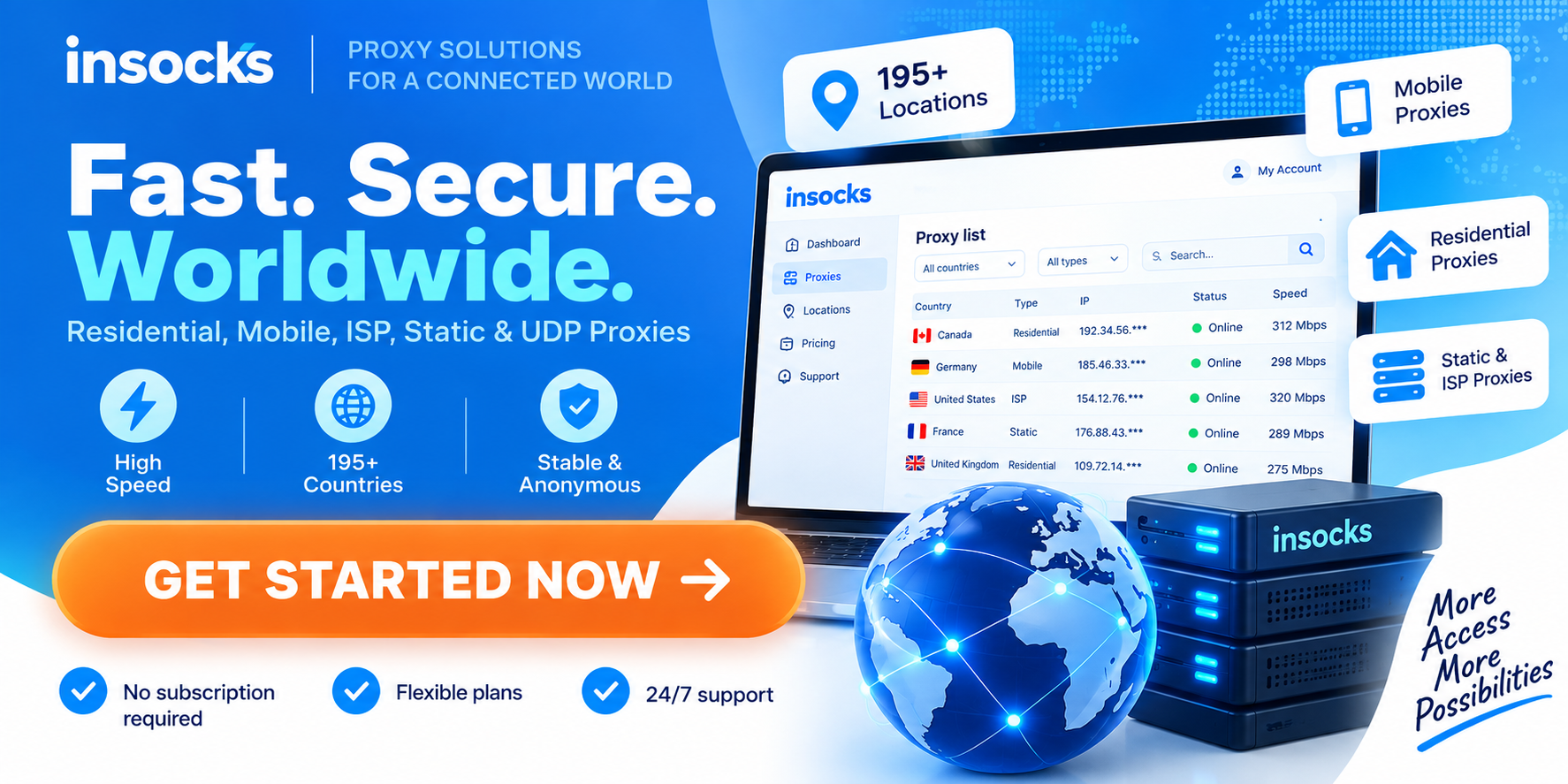
Consumer ISP addresses
Residential IPs are normally linked to broadband providers serving households. Their registration differs from datacenter addresses, which are commonly associated with hosting companies or cloud networks. This distinction can matter when teams want their testing environment to reflect ordinary home internet connectivity rather than server infrastructure ✅.
Geographic targeting options
Location selection is one of the most useful residential proxy features. Depending on available infrastructure, services may offer country, region, state, or city targeting. Businesses can use this flexibility to review how public websites display currencies, languages, products, search results, or promotional content across different markets.
Sticky sessions for longer tasks
Some workflows need the same residential IP for several minutes or longer. Sticky sessions are designed for these situations by keeping one endpoint active throughout a defined period. They can simplify multi step localization checks, browsing tests, and other processes where an unexpected IP change would make results harder to compare ✨.
Rotating sessions for wider coverage
Other projects benefit from controlled IP rotation. A residential proxy pool can assign a new endpoint according to time, request count, or session rules. Rotation can be useful for broad public market research across different locations, provided teams document when and why addresses change.
Practical business applications
Residential proxies can fit several legitimate workflows when companies define the purpose and traffic rules in advance.
- ✅ Verify localized website content and currencies
- ✅ Compare public search results across markets
- ✅ Review regional advertising destinations
- ✅ Monitor publicly available product information
- ✅ Test customer journeys from selected locations
- ✅ Support structured international market research
- ❌ Avoid accessing private systems without authorization
- ❌ Do not ignore website policies or legal requirements
Regional ecommerce checks
International ecommerce websites frequently adapt their content according to visitor location. Product availability, shipping options, currencies, discounts, and checkout information may differ between markets. Residential proxies can help ecommerce teams compare these public variations from relevant geographic environments without maintaining a physical connection in every country.
Advertising campaign verification
Digital advertising often uses geographic targeting. Marketing teams may need to confirm whether users in a target region reach the intended landing page and see the appropriate language or offer. Residential proxy access provides another method for checking public campaign destinations while maintaining documented location settings ✨.
Search and visibility research
Search results can vary according to location, language, device settings, and other signals. Residential connections allow SEO teams to compare public search environments in selected regions without depending only on the office network. Repeating checks under consistent settings helps separate genuine regional differences from accidental testing variations.
Features that influence practical value
Residential proxy performance depends on several factors working together. A large pool may appear impressive, but network size alone says little about geographic accuracy, endpoint reliability, or session control. Businesses should compare services using criteria that reflect the tasks they actually plan to perform ✅.
|
Feature |
What to evaluate |
Practical benefit |
|
Geographic coverage |
Required countries and regions |
Better localization checks |
|
Session control |
Sticky and rotating options |
Flexible workflow design |
|
Endpoint availability |
Reliable access during working hours |
Fewer interruptions |
|
Latency |
Response time on target sites |
Faster research |
|
Authentication |
Secure access methods |
Better account control |
|
Protocol support |
Compatibility with required tools |
Easier integration |
|
Documentation |
Clear setup instructions |
Faster deployment |
Connection stability
Residential endpoints can change because consumer networks are dynamic. Devices may disconnect, broadband sessions may restart, or an ISP may reassign an address. A reliable proxy infrastructure should handle these changes without creating excessive failed requests. Teams should evaluate stability over repeated sessions rather than through a single successful connection.
Speed and latency
Residential proxies are not always designed to deliver the lowest possible latency. Routing through consumer networks can introduce additional distance or congestion compared with datacenter infrastructure. For practical business work, predictable response times may be more valuable than occasional peak speed. Testing real target websites provides the most relevant measurement ✨.
Protocol compatibility
The proxy should integrate with the tools already used by the organization. HTTPS support is useful for browser based tasks, while SOCKS5 can provide broader application flexibility when required. Teams should test authentication, DNS behavior, and connection persistence before connecting residential infrastructure to larger workflows.
Authentication and access management
Proxy credentials should be managed like other business infrastructure credentials. Access should be limited to approved employees, applications, or systems. Centralized credential management can make it easier to remove users, rotate passwords, and separate projects when several teams share the same residential proxy service ✅.
Responsible automation
Scheduled monitoring and research can save time, but automation should remain proportionate to the business task. Excessive requests, uncontrolled retry loops, or poorly configured scripts can reduce data quality and create unnecessary traffic. Responsible automation uses sensible intervals, clear error handling, and accurate logging ❌.
Privacy and security
Residential proxies change the visible IP address but do not replace cybersecurity controls. Sensitive information should still travel through encrypted protocols, and account access should use strong authentication. Organizations should also protect proxy credentials, secure testing devices, and maintain clear internal rules describing who may use the network.
Testing before expansion
A pilot project helps determine whether the service performs well in required locations. Teams can test several representative markets, record connection failures, compare sticky and rotating sessions, and verify geographic accuracy. Repeating these tests over multiple days gives a more realistic view of network reliability ✨.
Choosing features around the task
Not every project needs the same residential proxy configuration. Regional QA may prioritize sticky sessions, while broader market analysis may need controlled rotation across many endpoints. Advertising teams may care most about geographic accuracy, whereas technical teams may focus on protocol compatibility and latency. Selecting features according to the real workflow prevents unnecessary complexity.
Building useful residential proxy workflows
INSOCKS residential proxies can support practical digital operations when location, consumer ISP routing, and session flexibility are important. Their value comes from combining geographic access, controlled IP behavior, secure authentication, compatible protocols, and reliable infrastructure. When teams test these elements carefully and use them within clear operational rules, residential proxies can become a dependable tool for international research, localization, monitoring, and quality assurance ✨.