



When you think of Suzuki, chances are a small car comes to mind. Maybe it’s the Swift, the fuel-efficient Celerio, or even the quirky S-Presso. These are the cars that helped Suzuki build its reputation as a small-car expert, and for good reason. They are practical, easy to drive, and have a certain character that makes them memorable.

That’s also why I expected Suzuki’s first battery-electric vehicle to be something small. Perhaps an electric hatchback designed for city driving, or something along the lines of the Celerio, which I happen to own.
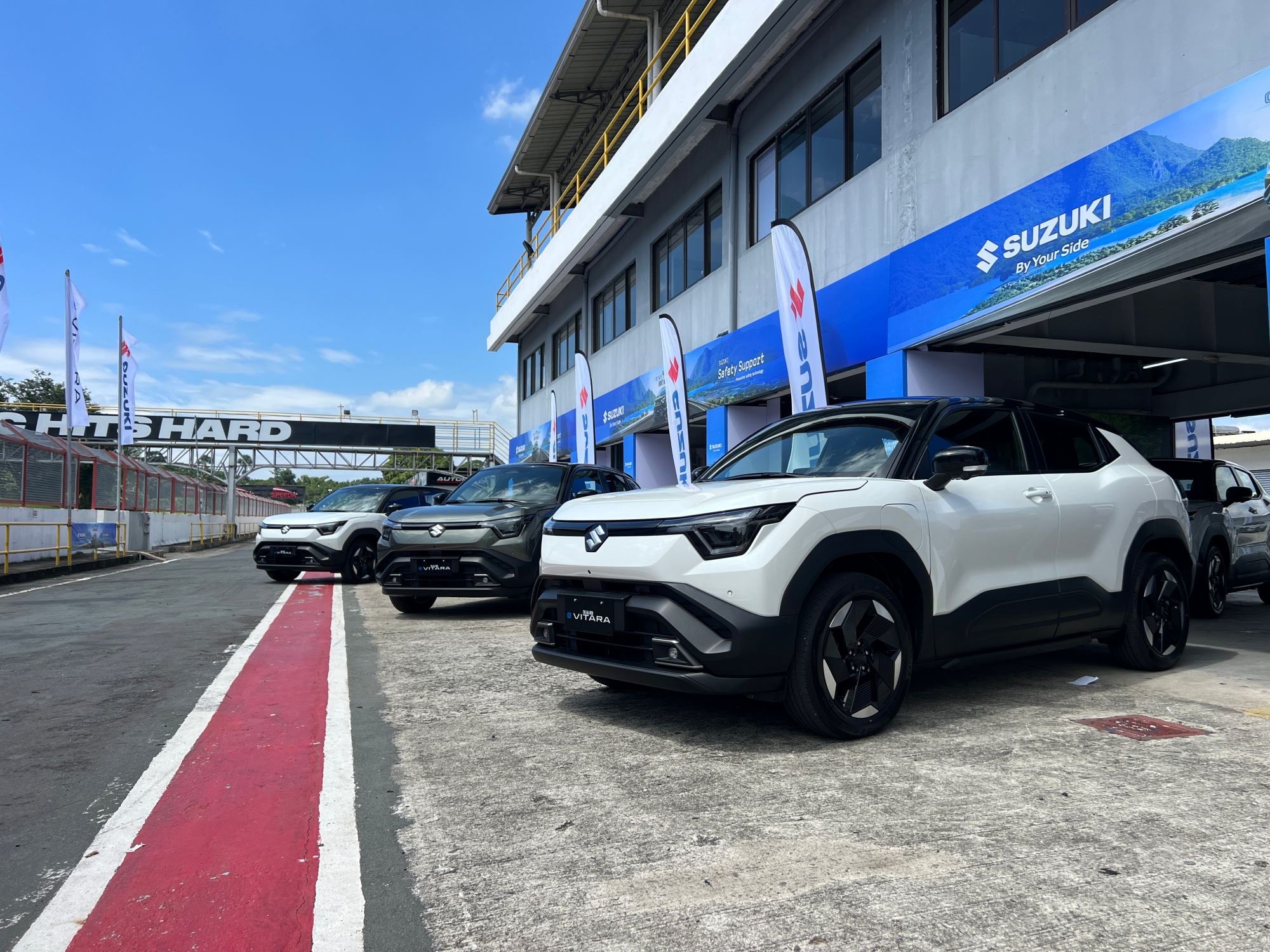
Instead, Suzuki went in a different direction. Unveiled locally at the 10th Philippine International Motor Show, the Suzuki e Vitara is a subcompact electric crossover priced at PHP 2,020,000. It’s bigger, more muscular, and considerably more expensive than the Suzukis we’ve grown accustomed to seeing on Philippine roads.


But having owned a Celerio, enjoyed driving the Swift, and recently taken a liking to the Fronx, I was curious to see whether Suzuki’s first EV would still feel like a Suzuki. Fortunately, I didn’t have to wait long to find out.
Suzuki invited us to Batangas Racing Circuit for a brief driving session with the e Vitara. With several members of the media sharing the vehicles, we had roughly four laps each to get acquainted with the car. It wasn’t enough for a full assessment, but it gave us a glimpse of what Suzuki has been working on.


The first thing you’ll notice is how different the e Vitara looks from the brand’s smaller offerings. It continues the muscular styling introduced by the Fronx, this time with more angular lines and geometric details. There’s also plastic cladding around the body, giving it the appearance of a crossover ready to venture beyond paved roads. I find the overall design cohesive, even if it takes some getting used to seeing a Suzuki with this much visual flair.

The interior is another departure from what I’ve come to expect. A dual-screen panoramic setup dominated the dashboard, accompanied by a high center console, a rotary gear selector, rectangular air vents, and a two-spoke steering wheel. It’s a modern-looking cabin, although I wish Suzuki had brought more of the exterior’s design language inside. I also found the absence of rear aircon vents unusual, especially considering the vehicle’s price.


As for space, the e Vitara should accommodate most Filipino families without much trouble. Headroom is respectable, while rear legroom is sufficient for adults. Things were a little snug for someone of my size, but that’s hardly a surprise. In fact, we managed to fit four adults inside during our track session. Two were of average build, while my fellow media colleague and I were considerably larger. Between the two of us, we probably weighed as much as three average-sized passengers. That made our group the equivalent of five adults, at least in terms of weight and yet the e Vitara didn’t seem bothered.

Even in Normal mode, acceleration was more than adequate. Unlike some electric vehicles that deliver a burst of power at the slightest touch of the accelerator, the e Vitara was more composed. The response was progressive, making it easier to control how quickly the vehicle gained speed. For everyday driving, that’s something I appreciate. Not everyone wants their morning commute to feel like a drag race.

But what impressed me most was the way the e Vitara handled corners. It drove with the eagerness of a much smaller car despite being a crossover. The steering responded well to my inputs, and the vehicle followed through corners with little need for correction. There was some body roll, as expected, but it remained controlled even when we tackled tighter turns at speeds exceeding 60 kph.

At times, it almost felt like playing an arcade racing game. Point the car toward a corner, press the accelerator, and let it do its thing. That’s when I began to recognize the Suzuki character I was looking for. The e Vitara may have grown in size and adopted an electric powertrain, but the driving experience reminded me of the brand’s smaller cars. It was easy to maneuver, responsive, and didn’t demand much effort from the driver.
Ride comfort also left a good impression. Batangas Racing Circuit has seen better days, yet the suspension managed the imperfections without making the cabin uncomfortable. Of course, driving on a racetrack is different from dealing with Metro Manila traffic, provincial highways, and the occasional pothole that seems large enough to swallow a wheel. We’ll need a proper road test to see how the e Vitara performs in those conditions.
Still, the brief experience brought back a phrase I often heard from fellow motoring journos before the pandemic: a small car on stilts. It’s a description that fits the e Vitara rather well.

Think of it as a Swift that has grown up, gained some muscle, and traded its gasoline engine for an electric motor. It offers more space and a different kind of power delivery, but the driving character remains familiar.
Personally, I think it could use a brighter exterior color to match that personality. For now, though, the e Vitara has made a good first impression. It turns out Suzuki didn’t have to make a small EV to preserve what makes its cars enjoyable.