



Some watches are associated with motor racing simply as a marketing exercise. Others, however, can trace that relationship directly through their history

The TAG Heuer Monza belongs emphatically to the latter group.
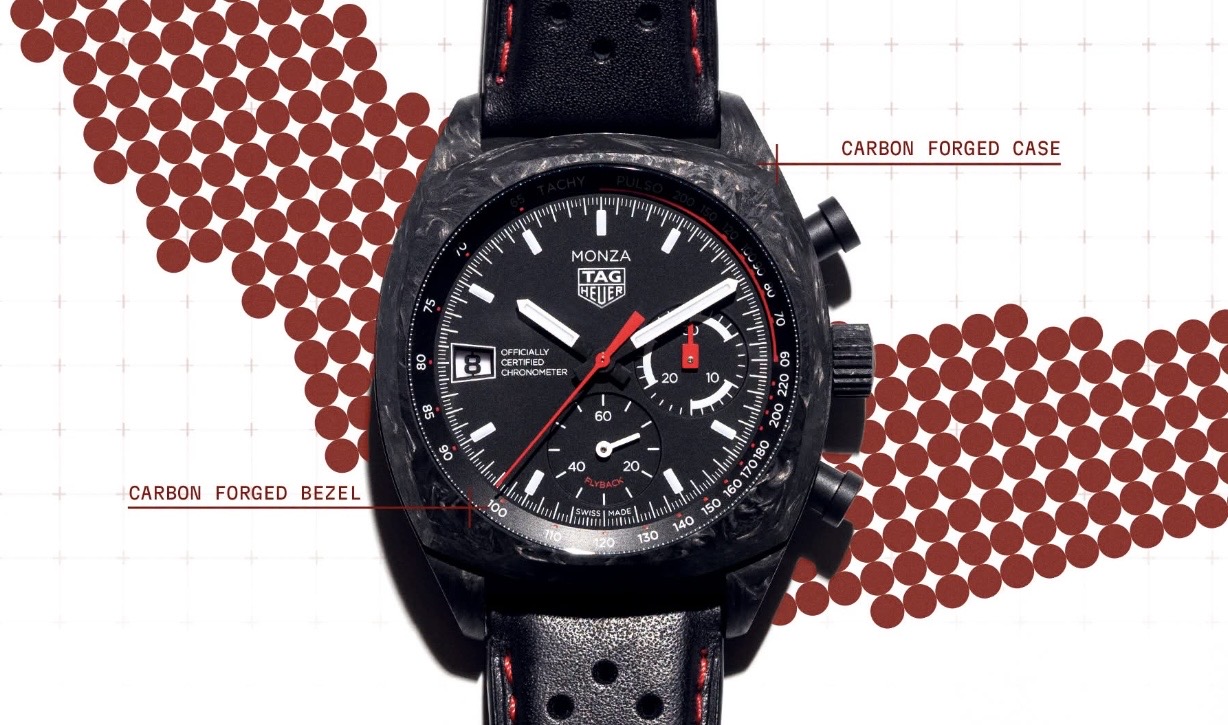
Now the Monza is back in a form that reconnects one of TAG Heuer’s most evocative names with the world of competition that inspired it. The new TAG Heuer Monza Flyback Chronograph combines an all-black aesthetic, forged carbon construction, flashes of racing red and a sophisticated flyback chronograph movement.
More importantly, it revives a name that carries considerable weight in TAG Heuer history.


Monza is not simply the name of a watch. It is the name of one of the most iconic Formula One racetracks in the world — and the connection between the two reaches back half a century.
The original Heuer Monza appeared in 1976, at a time when the watchmaker’s identity was becoming deeply intertwined with the highest forms of racing. TAG Heuer describes the contemporary Monza as a tribute to the brand’s “indelible link” with competition motorsport. It is an important distinction: the Monza is not simply styled to resemble a racing watch. Its racing character is rooted in the history of the model itself.
The new Monza immediately announces its intentions visually. Its 42mm case and fixed bezel are fashioned from forged carbon, giving the watch an unmistakably modern high-performance character while keeping weight down. The caseback is Grade 5 titanium — another ultra-light and ultra-strong F1 material — with a black PVD coating, while water resistance is rated at 100 meters.


But it’s the dial that establishes the strongest visual connection with the Monza’s racing personality. Against the matte-black background are crisp white elements and vivid red accents. White lacquered hands and white Super-LumiNova indexes provide high contrast and excellent legibility, while the red details give the watch the visual energy expected of a racing chronograph.
Perhaps the most evocative heritage detail appears around the dial. The Monza incorporates a dual-scale flange carrying both tachymeter and pulsometer scales. The tachymeter is naturally at home on a racing chronograph, providing a means of calculating speed over a known distance. The pulsometer provides an intriguing counterpoint. Rather than measuring the performance of the machine, it provides a scale to measure the human heartbeat. Two counters provide the chronograph indications, tracking elapsed minutes and running seconds.
The mechanical centerpiece of the new watch is TAG Heuer’s COSC-certified in-house Calibre TH20-12 Flyback, an automatic chronograph movement operating at 28,800 vibrations per hour and providing an impressive 80-hour power reserve.


It’s that flyback function that gives the movement its particular motorsport relevance.
TAG Heuer explains that timing a new interval with a conventional chronograph normally requires three operations: stop the chronograph, reset it and start it again. The flyback system compresses those operations into a single action. Press the appropriate control and the chronograph can reset and immediately restart without interruption.
In an environment where successive intervals need to be measured and fractions of a second matter, the logic is obvious. It also makes the complication seem tailor-made for a watch named after the fastest racetrack in the world.
Even the strap continues the theme. TAG Heuer pairs the watch with a black perforated leather strap, complemented by a black DLC-coated folding clasp with double safety push buttons. The perforations reinforce the watch’s sporting appearance and recall a familiar visual language from the world of car racing. Taken together with the forged-carbon case, black dial, white indications and red highlights, the effect is unmistakably motorsport-oriented.
The new TAG Heuer Monza Flyback Chronograph is limited to 500 pieces, giving this latest interpretation an appropriately special place within the collection. Half a century after the Monza name first appeared on a Heuer chronograph, it once again sits on the dial of a black, purposeful timing instrument created around the idea of speed.